Sébastien Han
656dd0f334
Sébastien Han
656dd0f334
Our admission webhooks will now run as part of the Operator container
and not an additional deployment. This has the advantage of consuming
fewer resources in the cluster and not having to manage affinities and
tolerations. This only drawback is that the Secret containing the
certificates is not mounted anymore and the content needs to be written
inside the Operator. This is not practical since we also need to watch
for the Secret content to change. Meaning that the certificates have
been renewed and the webhook server needs to use them.
A new approach is on its way to hopefully simplify this last issue and
implement a watcher for the Secret.
In the meantime, users need to use the cert-manager or renew
certificates manually. Additionally, they must update the
ValidatingWebhookConfiguration object with the new CA bundle.

Signed-off-by: Sébastien Han <seb@redhat.com>







What is Rook?
Rook is an open source cloud-native storage orchestrator for Kubernetes, providing the platform, framework, and support for a diverse set of storage solutions to natively integrate with cloud-native environments.
Rook turns storage software into self-managing, self-scaling, and self-healing storage services. It does this by automating deployment, bootstrapping, configuration, provisioning, scaling, upgrading, migration, disaster recovery, monitoring, and resource management. Rook uses the facilities provided by the underlying cloud-native container management, scheduling and orchestration platform to perform its duties.
Rook integrates deeply into cloud native environments leveraging extension points and providing a seamless experience for scheduling, lifecycle management, resource management, security, monitoring, and user experience.
For more details about the storage solutions currently supported by Rook, please refer to the project status section below. We plan to continue adding support for other storage systems and environments based on community demand and engagement in future releases. See our roadmap for more details.
Rook is hosted by the Cloud Native Computing Foundation (CNCF) as a graduated level project. If you are a company that wants to help shape the evolution of technologies that are container-packaged, dynamically-scheduled and microservices-oriented, consider joining the CNCF. For details about who's involved and how Rook plays a role, read the CNCF announcement.
Getting Started and Documentation
For installation, deployment, and administration, see our Documentation.
Contributing
We welcome contributions. See Contributing to get started.
Report a Bug
For filing bugs, suggesting improvements, or requesting new features, please open an issue.
Reporting Security Vulnerabilities
If you find a vulnerability or a potential vulnerability in Rook please let us know immediately at cncf-rook-security@lists.cncf.io. We'll send a confirmation email to acknowledge your report, and we'll send an additional email when we've identified the issues positively or negatively.
For further details, please see the complete security release process.
Contact
Please use the following to reach members of the community:
- Slack: Join our slack channel
- Forums: rook-dev
- Twitter: @rook_io
- Email (general topics): cncf-rook-info@lists.cncf.io
- Email (security topics): cncf-rook-security@lists.cncf.io
Community Meeting
A regular community meeting takes place every other Tuesday at 9:00 AM PT (Pacific Time). Convert to your local timezone.
Any changes to the meeting schedule will be added to the agenda doc and posted to Slack #announcements and the rook-dev mailing list.
Anyone who wants to discuss the direction of the project, design and implementation reviews, or general questions with the broader community is welcome and encouraged to join.
- Meeting link: https://zoom.us/j/392602367?pwd=NU1laFZhTWF4MFd6cnRoYzVwbUlSUT09
- Current agenda and past meeting notes
- Past meeting recordings
Project Status
The status of each storage provider supported by Rook can be found in the table below. Each API group is assigned its own individual status to reflect their varying maturity and stability. More details about API versioning and status in Kubernetes can be found on the Kubernetes API versioning page, but the key difference between the statuses are summarized below:
- Alpha: The API may change in incompatible ways in a later software release without notice, recommended for use only in short-lived testing clusters, due to increased risk of bugs and lack of long-term support.
- Beta: Support for the overall features will not be dropped, though details may change. Support for upgrading or migrating between versions will be provided, either through automation or manual steps.
- Stable: Features will appear in released software for many subsequent versions and support for upgrading between versions will be provided with software automation in the vast majority of scenarios.
| Name | Details | API Group | Status |
|---|---|---|---|
| Ceph | Ceph is a distributed storage system that provides file, block and object storage and is deployed in large scale production clusters. | ceph.rook.io/v1 | Stable |
| Cassandra | Cassandra is a highly available NoSQL database featuring lightning fast performance, tunable consistency and massive scalability. Scylla is a close-to-the-hardware rewrite of Cassandra in C++, which enables much lower latencies and higher throughput. | cassandra.rook.io/v1alpha1 | Alpha |
| NFS | Network File System (NFS) allows remote hosts to mount file systems over a network and interact with those file systems as though they are mounted locally. | nfs.rook.io/v1alpha1 | Alpha |
| CockroachDB | CockroachDB is a cloud-native SQL database for building global, scalable cloud services that survive disasters. | cockroachdb.rook.io/v1alpha1 | Deprecated* |
| EdgeFS | EdgeFS is high-performance and fault-tolerant decentralized data fabric with access to object, file, NoSQL and block. | edgefs.rook.io/v1 | Deprecated* |
| YugabyteDB | YugabyteDB is a high-performance, cloud-native distributed SQL database which can tolerate disk, node, zone and region failures automatically. | yugabytedb.rook.io/v1alpha1 | Deprecated* |
* CockroachDB, EdgeFS, and YugabyteDB were removed from Rook in v1.6. See Rook v1.5 docs if still interested. For YugabyteDB, see the replacement operator here.
Official Releases
Official releases of Rook can be found on the releases page. Please note that it is strongly recommended that you use official releases of Rook, as unreleased versions from the master branch are subject to changes and incompatibilities that will not be supported in the official releases. Builds from the master branch can have functionality changed and even removed at any time without compatibility support and without prior notice.
Licensing
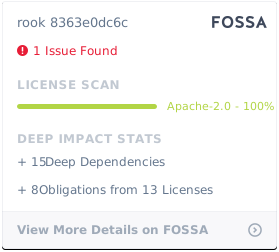
Rook is under the Apache 2.0 license.